
Shabbat Naso: Samson and Toxic Masculinity
(A d’var Torah delivered by Rabbi Sacks on June 2, 2023)
This week our haftarah especially compels us to think about men and masculinity. So before we think about the haftarah, let’s get some Jewish views on men. Think about what each quote might be saying–and not saying–about men and masculinity.
- “Women are more compassionate than men.”–Rashi
- “Men make mistakes not because they think they know when they do not know,
but because they think others do not know.”–Shalom Aleichem
- “Whether women are better than men I cannot say–but they are certainly no worse.”–Golda Meir
- “Men and nations behave wisely once they have exhausted all the other alternatives.”–Abba Eban
- “Men don’t care what’s on TV. They only care what else is on TV.”–Jerry Seinfeld
None of these quotations suggests anything positive about men and masculinity. Rather, they speak about men’s lack of compassion or wisdom, and they suggest that men will purposely make mistakes if they can get away with it, that they are always on the lookout for something better, and that the worst woman is likely to be an improvement on the whole lot of men.
So, nu, who is it that we hope our young boys grow into? When the 13-year old proudly announces on his special day, “Today I am Bar Mitzvah. Today I am a man!” What is it that we hope he’ll feel and be. What should Jewish men represent?
This week’s Haftarah portions help us to understand toxic masculinity.[1] It describes the miraculous birth of Samson. Born a nazir, a holy ascetic, and blessed with superhuman strength and a voracious id, Samson’s life is the diametric opposite of the Torah’s ideal of righteousness. Impulsive, undisciplined, unreflective, violent, lustful, vengeful, and vain, Samson is testosterone personified. He seems entirely wired for sex and violence, shamelessly pursuing his lust for women and murdering mercilessly to settle personal scores, until he is finally seduced and betrayed by the sultry Delilah whose wiles he cannot resist.
Hollywood loves this character. Cecile B. DeMille’s “Samson and Delilah,” starring Victor Mature and Hedy Lamarr, became 1950’s highest grossing film, and the third highest grossing film of all time. According to Variety, the film portrays Samson as a stereotypical “handsome but dumb hulk of muscle.”
Months later Billy Wilder made Sunset Boulevard. De Mille’s play himself The fictional silent film star, named Norma Desmond and played by Gloria Swanson, is portrayed as having once worked as an actress for DeMille. For the scene in which Desmond visits DeMille at Paramount, an actual set of Samson and Delilah was reconstructed to show the director at work.
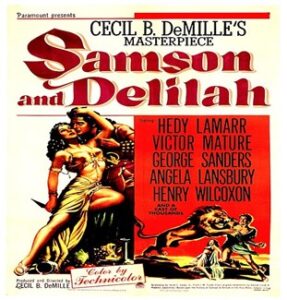
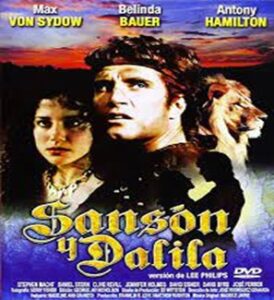
In 1984, Antony Hamilton played Samson opposite Belinda Bauer heading a cast that included Max von Sydow, Jose Ferrer, Victor Mature, Stephen Macht, and Daniel Stern.
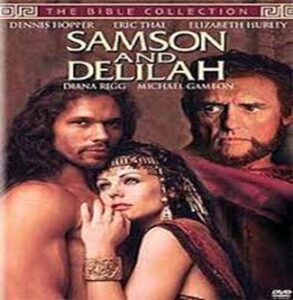
The 1996 miniseries starred Eric Thal opposite Elizabeth Hurley, and included Dennis Hopper, Diana Rigg, and Michael Gambon in the cast.
The 2018 remake stars Taylor James opposite Caitlin Leahy, with a cast that includes Billy Zane, Lindsay Wagner, and Rutger Hauer.[2]

Hollywood loves Samson because Hollywood loves testosterone. To date, we’ve enjoyed ten main “Fast and Furious” films, not counting several spinoffs. The Wikipedia listing of movies based upon Marvel Comics contains 67 movies with five more coming in the next year and a half. This includes Iron Man, Hulk, Thor, Captain America, et al. Some 37 films have been made of DC Comics adventures with figures like Superman and Batman, and we have had 27 James Bond movies.
What do our young boys learn of masculinity from American popular culture? In movies, on TV, in popular music and video games, even on the evening news, men use, abuse and silence women. Violence is the modern emblem of true manliness. Everywhere he looks, every bar mitzvah boy finds Samson’s spiritual descendants.
The Jewish tradition thought differently. Though Samson was a biblical Judge, the sages of Jewish tradition found his character troubling. Only in his sad fate do they find morality. Thus the Talmud[3] teaches, “Samson rebelled against God through his eyes, therefore the Philistines put out his eyes.”
The sages read Samson as the Shadow, the dark underside of an ideal of Jewish masculinity. Samson is a loner; each of his feats is done by himself and for himself. The ideal Jewish Man lives a life enveloped in family and community.
Samson is a warrior; his power measured in body counts, his heroism proven in bloody battle. To the Jewish Man, violence is an anathema.
The Jewish Man becomes a hero by studying, if not entirely mastering, Torah and by mending the world’s brokenness. His aggression is sublimated into Talmudic debate, his prowess demonstrated in self-control, his valor proven through selfless acts of compassion. Samson, on the other hand, uses women, until in the end, a woman uses him and destroys him.
The Jewish Man embraces an ethic of id, the holiness of true intimacy, sharing the creation and nurturing of a family and thereby gaining a share of immortality.
For almost 20 centuries, this was the ideal of the Jewish male–scholarly, gentle, and pious. But over time this devolved into meekness, passivity, and impotence. In 1903, Chaim Nahman Bialik, poet laureate of Zionism, was sent to report on the Kishinev pogrom. He was shocked by the vicious slaughter. But more, he was appalled at the meek submission of the community’s men. In his poem B’Ir Ha-hareigah, “In the City of Slaughter,” he decries Jewish men who could not or would not defend their wives from rape and their children from murder. Bialik and the Zionist revolution overthrew the tradition’s ideal of gentle masculinity. They revisited Samson, reveling in his confidence and power, his physicality and vitality.
The literary masterwork of Vladimir (Zev) Jabotinsky, father of Revisionist Zionism, was his novel, Samson the Nazirite, which was the source and heart of DeMille’s screenplay. Indeed, Jabotinsky was given a screenwriting credit on the film, even though he died over nine years before it was released.
Zionism promised a New Jewish Man–natural and free, strong and unafraid. Following the Six Day War in 1967, many hung posters of Moshe Dayan in our dens or bedrooms. Here was the new Jewish masculinity–cocky, brave, and strong. After centuries of fear, humiliation, oppression–and in the wake of the Holocaust, we could finally be proud of this new model of Jewish manliness.
But just as the tragedy of Samson predicted, this exaltation of crude masculinity eventually turned monstrous. Harvey Weinstein was only the one in a long line of visible Jewish men accused of sexual abuse, a list that includes celebrities and public figures such as Dustin Hoffman, Leon Wieseltier, Jeffrey Tambor, Mark Halperin, James Levine, Jeremy Piven, Woody Allen, Brett Ratner, and Bruce Weber.[4]
A former president of Israel, among several powerful Israeli leaders, was convicted and jailed for sexual abuse of female subordinates. Indeed, leaders of ultra-Orthodox communities, including in Israel, have similarly been convicted. Just last year an Israeli rabbi and popular author committed suicide after allegations of abuse of over 20 people. The Ashkenazi Chief Rabbi made headlines by attending his shivah without offering any support to the victims. This episode followed the revelation that another ultra-Orthodox leader in Israel had been abusing men, women, and children since the 1980s. He succeeded in committing suicide.
Likewise, Samson’s story concludes on a grim note, with murder and suicide, not Kiddush Ha-Shem. There was no sanctity in his life, and none in his death. That is the inevitable end of this model of masculine strength.
We owe our young boys, and ourselves, a new paradigm of Jewish masculinity. Perhaps a synthesis of the old and the new–the gentleness of the tradition wedded to the strength of the Zionist ideal. But perhaps it’s time to put aside stereotypes and grapple with Samson against the backdrop of our prophetic tradition and calling, and to grapple with today’s toxic masculinity, against the backdrop of the ethical values we espouse today.
Let us pray that we have the strength now to start raising a generation of boys who will have a heart dedicated to caring and mending the world yet with hands capable of bringing down the pillars of injustice and evil. We pray for fierce conviction but soft hands. And we pray that their eyes remain broad and open, their hearts overflowing with love, and their actions replete with derekh eretz, with decency. Amen.
[1] The Torah portion also helps us to see this as well through the ordeal that a wife is put through when her husband suspects her of infidelity. We are by-passing a discussion of this due to time.
[2] Yet other movie versions were made. In 1922 Alexander Korda, the great Jewish director, producer and screenwriter, made Samson and Delilah, an adaptation and updating of Camille Saint-Saens’ 1877 opera, made at the height of the Austrian film industry. The British made a 26-minute short film in 1985, based upon D.H. Lawrence’s short story, “Samson and Delilah.” It starred Bernard Hill and Lindsay Duncan. In 1987, a Dutch version sets the story in the Netherlands and brings in the occult. The 2009 Australian version sets the story among local aboriginal peoples.
[3] BT Sotah 9b.
[4] This is a partial list. It should be noted that these are allegations. Most of these on this list have not been convicted in a court of law.