
Seventh Day Pesach: Quotes about Slavery/Freedom and a Painting
(A community study and d’var Torah led by Rabbi J.B. Sacks on April 12, 2023)
On the first morning of Pesach, we took time to discuss quotes about slavery and freedom, and how they might resonate with us. Please refer to your handout. Then we focused on the first page. Today we’ll focus on page 2. I will read each quote aloud slowly, since we sometimes hear things differently than when we read them to ourselves. As I read them, you are welcome to follow along on your handout, or just close your eyes and take these quotes in. Moreover, as I read them, please listen for what’s resonating for you. As you listen, try to be in touch with what’s speaking to you, challenging you, guiding you, calling you. After I have read them all, I will invite you to react to one quote only, and explain how it speaks to you today.
So, get comfortable. Take a few deep breaths. Please listen with open hearts!
Anne Frank (1929-1945, diarist, Shoah victim)
I’ve found that there is always some beauty left — in nature, sunshine, freedom, in yourself; these can all help you. Look at these things, then you find yourself again.
John Locke (1632-1704, philosopher and physician)
Where there is no law, there is no freedom.
- Monique Wittig (1935-2003, Feminist theorist, philosopher, and author)
There was a time when you were not a slave, remember that. You walked alone, full of laughter, you bathed bare-bellied. You say you have lost all recollection of it, remember….Make an effort to remember. Or, failing that, invent.
Toni Morrison (1931-2019, novelist, essayist, and professor)
The function of freedom is to free someone else.
Ahad Ha’am (pen name of Asher Ginsberg, 1856-1927, Zionist thinker)
Freedom is taken, not given.
- Gloria Steinem (b. 1934, social-political activist and journalist)
Power can be taken, but not given. The process of the taking is empowerment in itself.
- Henry David Thoreau (1817-1862, naturalist and transcendalist)
Disobedience is the true foundation of liberty.
The obedient must be slaves.
- Angela Davis (b. 1944, activist, philosopher, academic, and author)
We have inherited a fear of memories of slavery. It is as if to remember and acknowledge slavery would amount to our being consumed by it.
Which quote was most interesting to you or most touched you, or was most relevant, or was most surprising, as I read it? Please do not just give us a quote number or author. Rather, please explain what the quote means to you or how it is speaking to you at this time.
(Discussion ensued.)
Please use these quotes to have a discussion at your Pesach tables with family or friends. This discussion starter can help gather in the wisdom that everyone contains.
This discussion leads us to consider the painting on the last page of the handout is by Eastman Johnson. Eastman Johnson was co-founder of the Metropolitan Museum of Art in New York City, and his name inscribed at its entrance. In his time, he was known as “the American Rembrandt.”
He was an early anti-racist. He drew portraits of the Ojibwe people, a First Nations group. He highly respected all of his subjects, and gave them all a realistic look. Previously most of the paintings of people of color were caricatures, and belied demonstrated a thinking that such subjects were not equal.
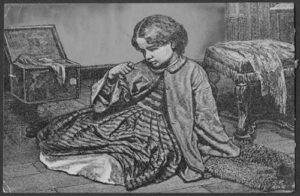
All of that background might help us unpack this painting, called “Freedom Ring.” A child sits on a tiger skin looking curiously and happily, it seems, at a jewel on her hand. We should, however, be aware that the ring is more than just a piece of jewelry. Behind it lies a story of a man who had the courage to speak out for freedom when those views were not always popular. In fact, what we have here is a story within a story.
The man behind the story was Henry Ward Beecher (1813-1887), the minister of Plymouth Church in Brooklyn Heights in pre-Civil War days. This great preacher, who could hold his congregation spellbound, even when he spoke for hours at a time, led all the abolitionists in his opposition to the Fugitive Slave Law. That 1850 law required even free states and even abolitionists to participate in returning escaped slaves to their enslavers. The idea of the law was unthinkable to Beecher and to his congregation, which was known as Grand Central Depot of the Underground Railroad.
Beecher condemned even his fellow preachers for refusing to speak out strongly enough against slavery, what he called “the blackest iniquity of the age.” He claimed that they condemn the small sins because it is safe, but they keep silent on the important sins. That group is courageous enough only to condemn a person for “using tobacco, but they can’t say one word against selling the men and women who raise it. It can spend itself and exert tremendous machinery against the awful sin of the dancing of young men and maidens but can’t utter a word when maidens are sold to prostitution and young men are driven off, in chain-gangs, to the rice swamps of Georgia.”
Beecher not only preached against the evil of slavery, but, as you heard, he spoke up against human trafficking, which now as then, affected mostly young women. He also spoke up against a criminal justice system that bore heavily on men of color.
But Beecher practiced what he preached as well. In February 1860, he brought to the pulpit a little girl of color, Sally Maria Diggs, who was known as Pinky, who was to be returned to slavery unless a certain sum of money could be raised for her ransom. He undertook to raise that sum at the service.
When he had finished telling the harrowing story of the little girl, purses flew open and the sum required was raised. But one little girl in the congregation, Rose Terry, had no purse; but she did have a valuable opal ring on her finger which she treasured. When the collection box reached her, she dropped the ring into the box.
Mr. Beecher, upon receiving the box, realized that they had raised well over the $2,200 dollars to emancipate the little girl. He saw the little ring, and lifted it from the mountain of coins and placed it upon the finger of the girl of color as a token of her freedom, exhorting her, “With this ring, I do wed thee to freedom. Now, remember, this is your freedom ring.” Pinky got an education and became a teacher, changing her name to Rose Ward, Rose after Rose Terry and Ward after Henry Ward Beecher. This became an iconic moment for the abolitionist movement.
Beecher himself brought Pinky to see Eastman Johnson to portray this young girl in 1860. Eastman Johnson had just had a successful exhibition at the National Academy of Design, which featured his masterwork, Negro Life in the South (1859).
The title of the work may well have a double meaning. Of course, it is literally a depiction of Rose Terry’s ring which was part of a collection to win Pinky’s freedom. It became symbolic of the fight for freedom for enslaved Americans of color. Indeed, the picture was reproduced and many abolitionists had a copy hanging in their home. The title also reminds us of the patriotic song, “My Country ‘Tis of Thee,” which ends “Let Freedom Ring.” That song actually subverts its music, previously used to reinforce the monarchy of England, with its astounding demand for freedom everywhere. As the title of this painting, Eastman Johnson seems to suggest that the song, if not a lie, is at best aspirational, since American democracy still allowed for the purchase and ownership of persons.
As we conclude Pesach today and tomorrow, we might do well to think about the meanings of freedom we have explored, and think about how freedom and democracy are going through difficult times right now, as evidenced by the many restrictive laws against abortion and the well over 425 anti-LGBTQ+ laws that have been introduced in state legislatures throughout the country, among other markers.
So let us ask on this Festival of Freedom. On this day that our ancestors crossed the Red Sea, we ask: What Red Seas do we need to cross? What can we subvert to help enhance the promise of democracy and the aspiration of freedom? May our taking on these questions lead us to action on behalf of all those not-yet-fully free in our own country, and we thereby demonstrate again that Judaism for us is not merely a museum of rituals another generation did, but a vision, an aspiration, that we undertake, to ensure that we, too, walk on the road to justice, and to freedom.
Amen.
Chag samei-ach. A joyful, meaningful, and liberating Pesach!