
PAINTING JERUSALEM: MODERN ARTISTS PORTRAY THE HOLY CITY
(A Torah Discussion with Rabbi Sacks given on May 20, 2023)
On Thursday night when we inaugurated Yom Yerushalayim. Fran showed the importance of Jerusalem to three major world religions: Judaism, Christianity, and Islam, and showed a key important location in Jerusalem for each. I explored how the artistic imagination has portrayed Jerusalem in art. Today I would like to continue that exploration with different artists. Before we begin, however, I’d like us to consider these three questions as we examine each piece of art. Those questions include:
What do you think the artist wanted to communicate about Jerusalem? What in the artwork leads you to say that (think of color, shapes, inclusion choices, et al)?
- Does anything here relate to anything in your experience of Jerusalem? Explain your response.
- What feeling/mood do you get from this artwork? What in the artwork leads you to say that?
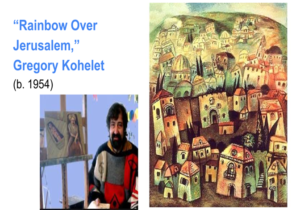
Gregory Kohelet was born in Fergana, Uzbekistan in 1954. He studied painting and emigrated to Israel in 1990. He lived in Jerusalem, where he was greatly inspired by the spiritual splendor of the city and became interested in the mysticism of the Kabbalah. A mixed-media artist as well as a writer and poet, Kohelet creates extraordinary pieces that have found themselves in galleries and collections all over the world. He has been living in Holland since 1998.
Kohelet is renowned for his distinctly abstract style,[1] and even cubist slant.[2] His work has been inspired by observing, experiencing, and respecting nature, and is influenced by both European art (including Modigliani and Brancusi) and Eastern art (including Japanese and Indian art), and the different places he has lived.
“Rainbow Over Jerusalem” is an 18” x 21” serigraph which whimsically portrays the iconic hills and buildings of Jerusalem. The unique colors and techniques used in this piece make everything appear as though it is being shown through a rainbow.
Please now consider: How do you react to this painting? What is the artist saying about Jerusalem? What intrigues you about this work?
- What might be Kohelet’s point about the rainbow–Does it suggest just the right “kismet” (G!d, light, fate) that Jerusalem has a special atmosphere? Is it that Jerusalem is composed of so many people from so many parts of the world representing so many cultures and languages that she is a rainbow? Or do you feel it might be something else?
- Some of the windows resemble eyes. What might be the import of this?
- Notice the closeness of the hills to the clouds. Does this suggest something about the closeness of heaven and earth that we feel when we’re in Jerusalem, or might it mean something else?
What else do you notice? How do you understand/interpret it?

Nahum Gutman was born in Romania (then Russia, now the Republic of Moldova). His father was a Hebrew writer (pen name S. Ben Zion) and educator. In 1903, the family moved to Odessa, and two years later, to Ottoman Palestine, living in the area of what would become Tel Aviv. He studied art at Bezalel in Jerusalem, and honed his skills in Vienna, Paris, and Berlin. He worked with many different media.
He created his own distinctive style. His art depicted a hidden, exotic Middle East, and won him acclaim both in Israel and across the world. Gutman was also a celebrated children’s author and illustrator, and was awarded the prestigious Israel Prize for Children’s Literature. He won many awards in virtually all of his various endeavors. His work is displayed in the eponymous Gutman Museum in Tel Aviv. [He’s actually better known for his depictions of Tel Aviv.]
“Jerusalem” is an 18.1” x 12.2” lithograph featuring rich tones across a muted background, depicting iconic Jerusalem views in beautiful color and Gutman’s unmistakable style. Set against a subdued background, this piece colorfully depicts various iconic symbols of Jerusalem, including the Church of Mary Magdalene (Russian Orthodox), the Tower of David and the Dome of the Rock, along with a collection of trees and non-descript buildings. It blends modern art and traditional symbolism.
Please now consider: How do you react to this painting? What is the artist saying about Jerusalem? What intrigues you about this work?
- Gutman’s rendering seems almost like folk art. How do you interpret this artistic choice?
- Gutman includes three iconic buildings, representing Muslim, Christian, and Jewish presences within the city. What might be Gutman’s message?
- What do you make of Gutman’s use of space and his color choices?
What else do you notice? How do you understand/interpret it?
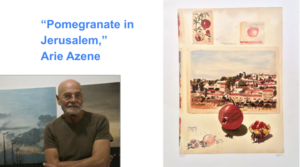
German-born Israeli artist Arie Azene was a member of the Ofakim Chadashim (“New Horizons”) art movement that strove to represent, rather than portray, reality. He uses diverse techniques and styles. Azene’s work includes watercolors and inspired 3D mixed-media pieces. A member of Kibbutz Palmach Tzuba, exhibits a clear inclination towards merging the color structure around two complementary hues, usually closely to one another. which have been exhibited in galleries around the world, including Israel, the U.S., Canada, Singapore, Belgium, Switzerland and Italy.
“Pomegranate in Jerusalem” is a 19.5″ x 27.5″ serigraph that combines two classic themes in Israeli art: the Seven Species and Jerusalem. A stunning landscape of Jerusalem, painted in warm tones and featuring a spectacular view of the tree-filled Artist’s Colony and Yemin Moshe (Montefiore windmill), is fronted by one round, red pomegranate and a segment of the fruit dripping with ripe seeds and juice. Pale pomegranates border this central image, with the word rimon, “pomegranate,” appearing in Hebrew in the bottom left corner.
The Seven Species (sheva minim) are a group of foods mentioned in the Torah as native to the land of Israel: wheat, barley, pomegranates, olives, dates, grapes and figs. Azene painted seven scenes of Jerusalem, with each dedicated to one of these Seven Species. Here Jerusalem retains the color tones of the pomegranate.
Please now consider: How do you react to this painting? What is the artist saying about Jerusalem? What intrigues you about this work?
- Pomegranates are a symbol of abundance in Judaism. Sephardic and Mizrahi communities eat pomegranates on Rosh HaShanah as a symbol of the hope for abundance in the coming year. Do you see this work as embodying that tradition? How so?
- Pomegranates in Judaism also symbolize other things, including beauty, fertility, joy, love, mitzvot (every pomegranate is said to contain 613 seeds, the number of mitzvot), passion, and sensuality. Do you see any of these in this work of art? Explain.
- Here there is greenery while Kohelet had virtually none. Even Gutman had much less. What might Azene be saying about Jerusalem through this depiction?
What else do you notice? How do you understand/interpret it?
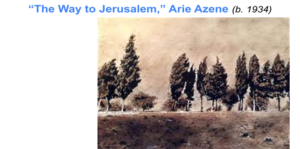
Here is another work by Azene, entitled, “The Way to Jerusalem.”
Please consider: How do you react to this painting? What is the artist saying about Jerusalem? What intrigues you about this work?
- What “way” do you see in this painting? Do you think Azene is trying to represent what it took to pave the way for modern Jerusalem with the pioneers or, perhaps, representing the way to a spiritual/mystical understanding of Jerusalem, or something else?
- Notice the lack of people or buildings in this work? What might this indicate?
- Notice the relative lack of color. What might this indicate?
What else do you notice? How do you understand/interpret it?
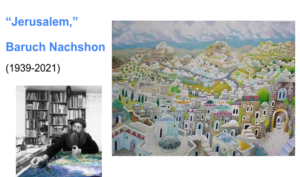
Baruch Nachshon was born in Haifa in 1939. In his youth he studied under Shlomo Nerani–Cezanne’s sole pupil. In early adulthood, he began a lifelong involvement with Lubavitch Chassidism, drawn in by their melodies. Today, his is the only artwork hanging in Lubavitch headquarters in New York. Following the Six-Day War in 1967 Nachshon and his wife Sara, were among the first Jewish settlers in Hebron (no Jewish presence since 1929). To underscore the significance of Jewish culture to the city, Nacshon opened a gallery of his art beside Ma’arat Ha-Mach-pelah, the Tomb of the Patriarchs and Matriarchs.
Nachshon’s art translates Biblical stories and rabbinic interpretations into visual art. He is known for his surrealist landscapes,[3] as well as his unusual colors and patterns. According to Nachshon, “the open sky means going beyond what is reality, seeing through.” He tried to find just the right angles for his paintings. Nachshon’s art covers a wide range of thematic material through equally diverse stylistic approaches, all of which are uniquely his own.
In 2015 Koren Publishing released a book of psalms illustrated by Nachshon and annotated by renowned Rabbi Adin Steinsaltz.
“Jerusalem is a 28.35″ x 16.6″ serigraph. The work portrays Jerusalem, including its stone buildings, domed roofs, rolling hills and Ottoman architecture.
Please consider: How do you react to this painting? What is the artist saying about Jerusalem? What intrigues you about this work?
- While there are domed buildings, there does not seem to be any specific religious marking (e.g. there is no Star of David, cross, or crescent) to identify any of them. What might this mean?
- Notice the lack of people. What might this indicate?
- Notice the wide range of colors employed, including olive tones. How do you interpret this?
- Notice as well how close the clouds/sky are to the buildings and hills/earth. How do you understand this?
What else do you notice? How do you understand/interpret it?
Today we explored four different artists–from Uzbekistan, Romania, Germany and Israel, each of whom drew inspiration from Jerusalem, but had distinct visions and different styles (e.g. abstract art, cubism, surrealism). I hope you found some paintings that resonated with your experience of and/or ideas about Jerusalem and her importance in our Jewish heritage. I hope that others stretched your thinking about Jerusalem. Certainly, I hope your connection to Jerusalem was confirmed and deepened, and let us think about art as a way to animate our soul in experiencing the world! Amen. Shabbat shalom!
[1] Abstract art is art that does not attempt to represent an accurate depiction of a visual reality but instead uses shapes, colors, forms and gestural marks to achieve its effect.
[2] In Cubist works of art, the subjects are analyzed, broken up, and reassembled in an abstract form. Instead of depicting objects from a single perspective, the artist depicts the subject from multiple perspectives to represent the subject in a greater context. Cubists want to show the whole structure of objects in their paintings without using techniques such as perspective or graded shading to make them look realistic. They want to convey the inner reality of things, just to show what they look like.
[3] Surrealism sought to channel the unconscious as a means to unlock the power of the imagination. Disdaining rationalism and literary realism, and powerfully influenced by psychoanalysis, surrealists believed that revelations could be found on the street and in everyday life. Surrealist imagery is probably the most recognizable element of the movement, yet it is also the most elusive to categorize and define. Each artist relied on their own recurring motifs arisen through their dreams or/and unconscious mind. At its basic, the imagery is outlandish, perplexing, and even uncanny, as it is meant to jolt the viewer out of their comforting assumptions.