As we approach Yom Yerushalayim (Jerusalem Day, this year May 18 [sundown]-May 19), recalling the time when we regained access to the Old City of Jerusalem, during the Six-Day War. We’ll be celebrating with a special Jerusalem Shabbat on May 21-22, with a special liturgy for the occasion on Friday night (beginning 7:30 p.m.) and special readings, songs, and poems at our Saturday morning services (beginning at 10 a.m.).
All Jews speak of Jerusalem as our people’s capital. Why is that? I suppose that many answers could be offered. To understand why it’s such a good question, let’s consider Jerusalem’s suitability for such an honor.
Certainly one important consideration is its accessibility. Yet throughout history Jerusalem has been highly inaccessible. It’s actually off the beaten track, up in the mountains, and far from the great highways that have existed to its East and to its West.
Furthermore, Jerusalem is not a port city and does not have access to the coast. Therefore ships can’t reach it. Indeed, no rivers run through it, providing the additional challenge to her residents of having no natural source of water.
So, nu, why was it chosen? The answer is given in Psalm 132:
Ki vachar Hashem b’Tsiyon i-va l’moshav lo.
HaShem has chosen Zion, desiring it for Divine habitation.
Jerusalem has spiritual properties which are simply unmatched in any other place on earth. Those of you who have been privileged to visit Jerusalem known what I mean. The k’dusha, the holiness of the city permeates throughout, and we experience this. It is palpable. It is spiritually rejuvenating and uplifting for us all.
The properties of the city are furthermore expressed through the name of the city; the name is in the plural, Yerushalayim, as if to say “Jerusalems.” Now, only a few words in Hebrew which have no singular. For example, mayim, “water.” Even one drop of water is mayim (literally, “waters.”) Perhaps that’s because water as the basic substance that sustains lifes is everywhere–in the atmosphere and in every cell of every living thing.
Similarly, the word “shamayim,” the heavens: even one tiny piece of the sky is shamayim, in the plural, perhaps because the sky and atmosphere link all humanity, the entire earth, together.
We should add, most especially, the word chayim, “life.” Even one nanosecond of life is chayim, it’s in the plural (“lives”) and that is perhaps because life has so much potential, and life is social–we were not meant to live alone, by ourselves or for ourselves.
So too with the name Yerushalayim. It’s a city in the plural because it’s spirituality can affect and inspire everyone. It’s a city today that is holy to Judaism, Islam, and Christianity. It’s a city bustling with people of many nationalities, cultures, and languages.
Its spirituality seems to be Jerusalem’s compelling feature. King David wanted it for his capital not because of its Jewishness (it was not a Jewish city then), but because its spirituality gave it an aspect of unifying peoples. This helps explain why medieval maps drew Jerusalem not as the capital of a geopolitical place, but as the center of the universe. It’s that spiritual.
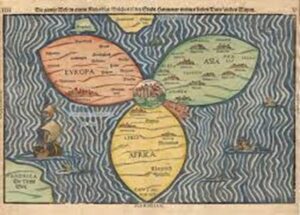
Map by Heinrich Bunting (c. 1580) with Jerusalem pictured (not labeled) in the center
Therefore on Yom Yerushalayim, let us celebrate that for 56 years, we have had unfettered access to all of Jerusalem and can bask in its spirituality. But we also pray that its unifying essence again prevails in our world, bringing all of her citizens together in a unified vision, and bringing Israel and all her neighbors together in a lasting, productive, meaningful, and lasting peace.
Yom Yerushalayim samei-ach. A joyful and meaningful Jerusalem Day, and please join us for our special Jerusalem Shabbat on May 21 (7:30 p.m.) and May 22 (10 a.m.), in our sanctuary or via our live stream.
Rabbi J.B. Sacks